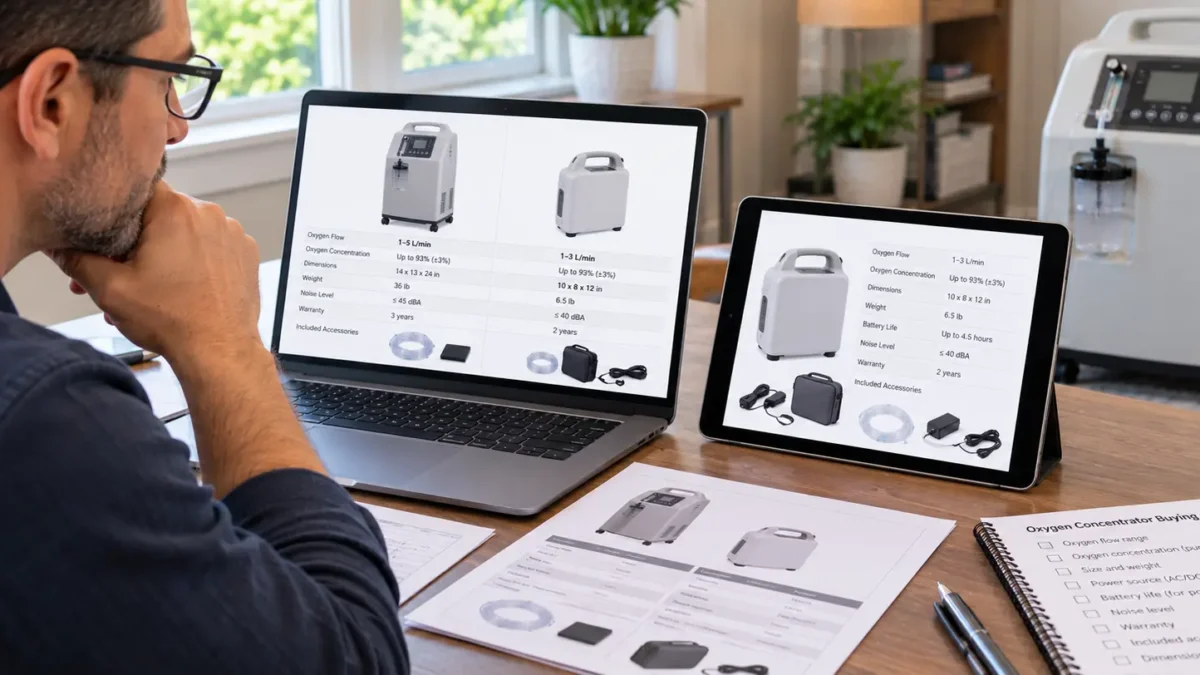
Knowing how to compare oxygen concentrator listings helps buyers identify important differences in equipment specifications, included accessories, warranty coverage, and supplier services. A product listing should provide enough information to evaluate whether a particular concentrator deserves further consideration.
However, the lowest price or highest advertised oxygen flow does not automatically indicate the most suitable equipment.
Home oxygen concentrators are medical devices, and their specifications must match the patient’s prescribed oxygen requirements. Therefore, buyers should compare product information systematically and verify important details with the manufacturer or authorized supplier before purchasing.
How to Compare Oxygen Concentrator Listings by Manufacturer and Model
The first step is confirming the equipment’s manufacturer, model number, and product category.
Different concentrators may have similar appearances or marketing descriptions while offering different operating characteristics.
For example, a product described simply as a five-liter oxygen concentrator may not provide enough information to establish its precise specifications.
A reliable listing should clearly identify:
- Manufacturer or brand name.
- Exact product model.
- Stationary or portable equipment category.
- Intended electrical supply.
- Available oxygen delivery settings.
- Relevant manufacturer documentation.
These details help buyers avoid confusing similarly named products. In addition, they make it easier to compare retailer information against official technical documents.
Compare Oxygen Concentrator Specifications Before Buying
Technical specifications are among the most important details to examine.
However, buyers should interpret individual specifications together rather than consider them in isolation.
Compare Oxygen Flow Range
Manufacturers commonly express oxygen flow in liters per minute (LPM).
For stationary continuous-flow concentrators, the stated range indicates the supported adjustable flow settings.
For example, a concentrator with a maximum flow of 5 LPM will not necessarily suit every patient who requires oxygen therapy.
The equipment must support the prescribed delivery method and flow requirements.
Check Oxygen Concentration and Purity
Oxygen concentration describes the proportion of oxygen in the gas that the concentrator produces.
Manufacturers may specify an expected concentration range under particular operating conditions.
Therefore, buyers should check whether a listing provides a meaningful concentration specification rather than a vague claim about oxygen purity.
Oxygen concentration at the equipment outlet also differs from the patient’s blood oxygen saturation.
Compare Electrical Requirements
Stationary concentrators generally require household electricity.
Consequently, buyers should confirm voltage, frequency, and any other relevant electrical specifications.
Equipment designed for one electrical market may not work directly with another market’s power supply.
This consideration becomes especially important when purchasing imported medical equipment.
Verify Product Listings Against Manufacturer Documentation
Retailer descriptions can provide a useful starting point, but manufacturer documentation offers an important reference.
For example, buyers examining o2xpress.com can review the Oxygen Express listing for the Drive DeVilbiss 525KS stationary oxygen concentrator.
They can then compare the retailer’s information with the official Drive DeVilbiss Healthcare operating manual and technical specifications.
This process helps distinguish manufacturer-defined equipment characteristics from general retail descriptions.
If a listing omits important information or appears inconsistent with official documentation, buyers should request clarification before ordering.
The U.S. Food and Drug Administration’s guidance on home oxygen therapy also explains important safety considerations for oxygen concentrator use under medical supervision.
Compare Oxygen Concentrator Accessories and Package Contents
Not every oxygen concentrator listing includes the same accessories.
Some packages may contain basic delivery components, while others may require separate purchases.
Therefore, buyers should verify exactly what the quoted price includes.
Relevant questions include:
- Does the package include a compatible nasal cannula?
- Does the supplier provide oxygen tubing?
- Is a humidifier bottle available, if appropriate?
- Does the package contain the required connectors?
- Does the equipment include the correct power cord?
- Does the supplier provide the manufacturer’s operating manual?
The answers may affect both the total purchase cost and the equipment’s readiness for use.
However, included accessories must still meet the patient’s prescribed treatment requirements.
Compare Warranty Coverage and After-Sales Support
Warranty terms are another important comparison factor.
Two suppliers may advertise the same concentrator model but provide different service arrangements.
What Should an Oxygen Concentrator Warranty Explain?
A clear warranty should identify the coverage period, applicable conditions, and the process for requesting service.
Buyers should also determine whether coverage applies to particular components or excludes certain consumables.
In addition, they should ask whether authorized technicians handle repairs.
Why Does Local Supplier Support Matter?
Oxygen concentrators contain specialized mechanical and electronic components.
Consequently, access to qualified servicing can be important during long-term ownership.
For buyers in Hong Kong, local equipment support may also simplify communication about installation, accessories, and servicing arrangements.
However, buyers should confirm these services directly rather than assuming that suppliers include them.
Compare Oxygen Concentrator Prices and Total Ownership Costs
The advertised equipment price is only one part of the overall purchasing decision.
Other potential costs include:
| Cost Category | What to Verify |
|---|---|
| Equipment price | Exact model and included components |
| Delivery | Shipping charges and delivery arrangements |
| Accessories | Compatible items included or available separately |
| Electricity | Manufacturer-rated power requirements |
| Maintenance | Consumables and authorized servicing |
| Warranty support | Coverage, exclusions, and service procedures |
A lower initial price may not represent better overall value if essential accessories or support services cost extra.
Therefore, buyers should request a clear breakdown before comparing offers.
Why the Lowest Price May Not Offer the Best Value
Some suppliers may advertise a lower equipment price while charging separately for delivery or accessories.
Meanwhile, other offers may include additional services within the quoted price.
As a result, buyers should compare the complete purchasing package rather than relying on the initial price alone.
Identify Missing Information in Oxygen Concentrator Listings
Incomplete listings do not necessarily indicate poor equipment, but they can make informed comparisons difficult.
Buyers should request clarification when a product page lacks:
- An exact model number.
- Manufacturer-identifiable specifications.
- Clear oxygen delivery information.
- Electrical compatibility details.
- Warranty conditions.
- Supplier contact information.
Similarly, claims such as “medical grade” or “high performance” should not replace measurable technical specifications.
The most useful listings provide verifiable information rather than relying mainly on promotional language.
Should You Choose the Concentrator With the Highest Specifications?
Not necessarily.
A concentrator with a higher maximum flow rate, larger housing, or additional features is not automatically the best choice.
Equipment suitability depends on the patient’s prescription, operating environment, and practical requirements.
For example, a larger stationary unit may offer capabilities that one patient does not need while failing to address another patient’s mobility requirements.
Therefore, clinical suitability should take priority over specifications that appear impressive in a comparison table.
Final Checklist to Compare Oxygen Concentrator Listings
Before making a purchasing decision, buyers should review the most relevant equipment details.
- Confirm the exact manufacturer and model.
- Check oxygen flow and concentration specifications.
- Verify electrical compatibility.
- Review included accessories and package contents.
- Compare warranty conditions and servicing arrangements.
- Calculate the complete purchasing cost.
- Check manufacturer documentation for technical accuracy.
- Confirm that the equipment meets the patient’s prescribed oxygen requirements.
This checklist helps buyers compare available options consistently while avoiding decisions based solely on price or promotional claims.
Final Thoughts on Comparing Oxygen Concentrator Listings
Learning to compare oxygen concentrator listings makes it easier to evaluate equipment using consistent, verifiable criteria.
Start by confirming the exact manufacturer and model. Next, review oxygen delivery specifications, electrical requirements, included accessories, warranty coverage, and supplier support.
Where possible, cross-check retailer descriptions against official manufacturer documentation.
Most importantly, confirm that the equipment matches the patient’s prescribed oxygen requirements before purchasing.
A careful comparison helps buyers move beyond price and marketing claims toward a more informed medical equipment decision.