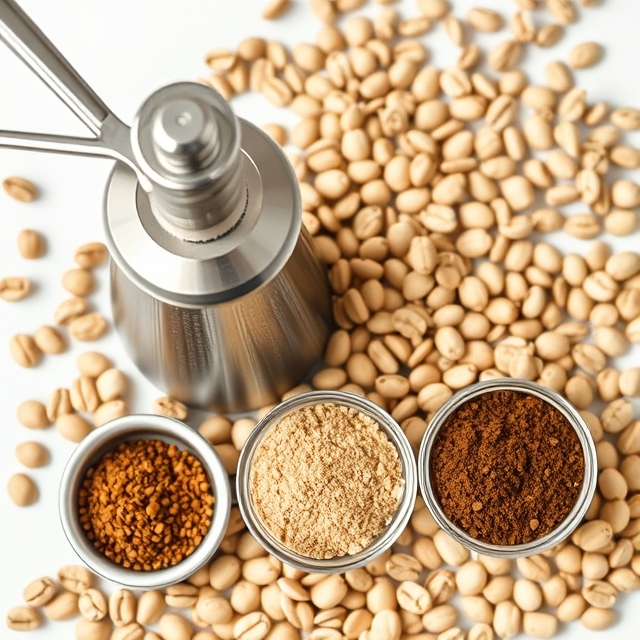
Choosing a grinder for dense lightly roasted beans requires a little more attention than selecting equipment for an everyday medium or dark roast. Very lightly roasted coffee can retain a firm, compact structure, making it more demanding to grind consistently. The right grinder should therefore provide reliable performance, suitable grind adjustment, and enough control for the brewing method being used.
For home brewers interested in exceptionally light coffee, understanding these differences can make preparation much easier.
Why Are Lightly Roasted Beans Difficult to Grind?
Roasting changes the physical structure of a coffee bean. As green coffee is exposed to heat, moisture leaves the bean and its internal structure changes. More developed roasting generally produces beans that are darker and more brittle.
Very light roasting produces a different physical result. Because the beans undergo less roast development, they can remain unusually dense and firm.
That density is one reason grinding exceptionally light coffee can feel harder than grinding a traditional roast. The grinder has to fracture the beans effectively while producing particles that are appropriate for the intended brewing method.
What Should You Look for in a Grinder?
When choosing equipment for dense lightly roasted beans, focus on four main characteristics: burr design, grinding consistency, adjustment range, and overall suitability for the intended workload.
1. Quality Burrs
A burr grinder is generally more appropriate than a blade grinder when consistent particle size matters.
Burrs break coffee beans between grinding surfaces and allow the user to select a particular grind range. Blade grinders, by comparison, chop the beans and can produce a wider mixture of particle sizes.
For dense light coffee, consistency is especially useful because grind size directly affects extraction. A reliable burr system gives the brewer more control when making adjustments.
2. Appropriate Grinding Capacity
A grinder should be capable of handling the amount of coffee you normally prepare.
Someone making a single cup occasionally has different requirements from someone preparing multiple espresso drinks every day. Dense beans can place additional demands on the grinding mechanism, so the manufacturer’s recommended usage should be considered.
More power alone is not a guarantee of better grinding. The burr system, motor, construction, and adjustment mechanism all contribute to performance.
3. Useful Grind Adjustments
Different brewing methods need different particle sizes.
Espresso generally requires a fine grind, while drip coffee usually uses a medium range. French press brewing typically calls for a coarse grind. Pour-over brewing can require further adjustment depending on the recipe and coffee.
A grinder with a useful range of settings allows the brewer to adapt the particle size rather than being restricted to one preparation style.
4. Consistent Particle Size
Consistency is often more important than grinding speed.
A grinder that produces a reasonably even particle distribution makes it easier to control extraction. If a batch contains too many very fine particles mixed with large pieces, water may interact with different parts of the coffee at different rates.
This can make the finished drink harder to balance.
With unusually light coffee, repeatable grinding gives the brewer a better foundation for adjusting water temperature, brew time, ratio, and other variables.
Should You Use a Manual or Electric Grinder?
Both options can work, but dense beans can make the difference between them more noticeable.
A manual burr grinder does not require an electric motor and can offer good control over grind size. However, grinding particularly dense beans by hand can require additional physical effort.
An electric burr grinder is generally more convenient for repeated preparation. Its suitability depends on the grinder’s construction and intended workload.
Before choosing either type, consider how often you brew, how much coffee you prepare, and whether you need fine control for espresso or another brewing method.
How Brewing Method Affects Grinder Choice
Your brewing method should influence the type of grinder you choose.
Espresso: Fine and repeatable adjustment is important because small changes in particle size can affect water flow and extraction.
Drip coffee: A dependable medium grind setting is usually more relevant than extremely fine adjustment.
French press: The grinder should be capable of producing a relatively coarse and consistent particle size.
Pour-over: Greater control can be useful because grind size works together with pouring technique, water temperature, and brewing time.
A versatile burr grinder can therefore be useful for someone who switches between several brewing methods.
What About Dense White Coffee?
Exceptionally light American-style white coffee can be particularly unusual because its beans are much denser than many familiar roasted coffees. The product information for one example describes the beans as too dense for ordinary home coffee grinders and notes that the coffee is supplied pre-ground using specialized grinding equipment.
That distinction matters when choosing equipment. Not every light roast has exactly the same physical characteristics, so a grinder that handles ordinary light-roasted coffee may not necessarily be appropriate for every exceptionally light white coffee.
For readers specifically exploring this style, grinding white coffee provides further information about the unusual density and preparation characteristics associated with white coffee.
When Is Pre-Ground Coffee More Practical?
Pre-ground coffee can be a sensible option when the beans are unusually hard and the available grinder is not designed for them.
Grinding immediately before brewing offers freshness and control, but those advantages are less useful if the grinder cannot produce an appropriate particle size or struggles to process the beans.
Pre-ground coffee also makes sense for people who do not want to invest in specialized grinding equipment. The key is to choose a grind appropriate for the brewing method.
Signs Your Grinder Is Not Suitable
Pay attention to how the grinder behaves.
Repeated stalling, unusual sounds, inconsistent grounds, or difficulty processing a normal dose may indicate that the grinder is not well suited to the coffee being used.
Do not repeatedly force a grinder that is clearly struggling. Instead, check its operating instructions and consider whether another grinder or a pre-ground option would be more appropriate.
Keeping the burrs and grinding chamber clean can also help maintain consistent performance.
Final Considerations
Choosing a grinder for dense lightly roasted beans is mainly about matching the equipment to the coffee and brewing method. A capable burr system, reliable grind adjustment, consistent particle production, and suitable workload rating are all useful characteristics.
Exceptionally light coffee may require more consideration than a conventional roast, but the basic principle remains simple: use equipment that can process the beans safely and produce the grind your brewing method requires. With the right setup, even unusual and dense light-roasted coffee can be prepared with much greater control.