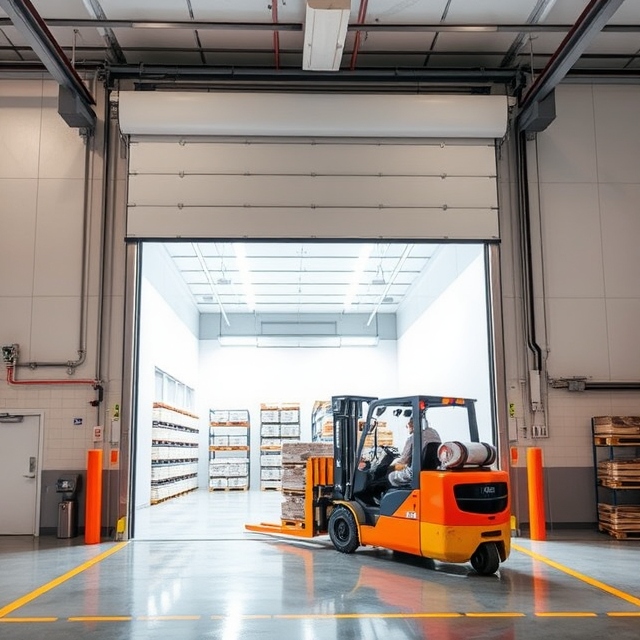
A high-traffic freezer room door needs to support frequent forklift and material movement while maintaining separation between the freezer and the surrounding area. The right choice depends on traffic frequency, opening dimensions, freezer temperature, available space, insulation, sealing, safety, and how quickly the doorway needs to operate.
A freezer entrance used only a few times a day has very different requirements from an opening through which forklifts move pallets repeatedly. For that reason, facilities should select the door around their actual workflow rather than choosing a door type based on appearance or size alone.
What Is a High-Traffic Freezer Room Door?
A high-traffic freezer room door is a cold-storage access door designed for frequent movement between a freezer and another area of the facility.
The doorway may connect a freezer to:
- A refrigerated warehouse
- A picking or packing area
- A production room
- A loading or staging area
- Another temperature-controlled zone
- An ambient warehouse aisle
The door needs to accommodate the physical movement of people and equipment while helping maintain the temperature separation required by the freezer.
For forklift applications, the opening should be wide and high enough for the vehicles and loads that actually pass through it. The operating method should also allow drivers to move through the doorway without creating unnecessary interruptions.
What Should You Consider Before Choosing the Door?
The first step is to understand how the doorway will be used.
Consider these questions:
- How frequently will the door open?
- Will forklifts or pallet trucks use the opening?
- What are the required opening width and height?
- What temperature does the freezer maintain?
- Is there enough wall space beside the opening?
- How quickly does the door need to open and close?
- Is automatic activation required?
- Are frost, condensation, or air leakage already problems?
- What safety equipment is needed?
- How much time can the doorway remain open during each traffic cycle?
These factors help determine whether a sliding, hinged, or high-speed configuration is appropriate.
When Is a Sliding Door a Good Choice?
A sliding door can be practical for freezer rooms where forklifts, pallets, or other large loads need to pass through a wide opening.
Unlike a hinged door, a sliding panel does not need a swing path across the floor. Instead, it moves horizontally along its track. This can make the surrounding traffic area easier to organize when floor space is limited.
Facilities may consider a cold storage sliding door when they need an insulated doorway for industrial cold-storage access and have suitable space for the door to move alongside the opening.
Sliding doors can be particularly useful when the door needs to provide a substantial insulated barrier while also accommodating larger material-handling routes.
However, the available wall space must be checked carefully. A sliding door needs sufficient clearance for the door panel and its operating hardware.
When Should You Consider a High-Speed Door?
A high-speed door becomes more relevant when the doorway experiences frequent traffic and rapid access is an operational priority.
For example, imagine a freezer distribution area where forklifts repeatedly travel between the freezer and an adjacent warehouse. If operators have to stop frequently to manually open a slow door, the doorway can become an interruption in the material-flow process.
An automatic high-speed system can open when authorized traffic approaches, allow the forklift to pass, and close again afterward.
This type of arrangement can be useful for:
- Busy freezer entrances
- Refrigerated distribution centers
- Cold-chain transfer areas
- Food-processing facilities
- High-frequency forklift routes
- Production areas connected to freezer rooms
The exact door configuration should still be matched to the freezer temperature and environmental conditions.
Sliding vs. High-Speed Doors for Freezer Traffic
Sliding and high-speed doors can both be suitable for freezer applications, but they address different operational priorities.
Sliding doors are generally considered when the facility needs a substantial insulated door and has enough side space for horizontal movement. They can work well for wide openings and material-handling access.
High-speed doors are more focused on frequent opening and closing. They can be useful where the doorway is part of a continuous traffic route and minimizing open time is important.
The choice does not have to be identical throughout a facility. A freezer storage room with occasional pallet access may use a different configuration from a busy connection between a freezer and a production or distribution area.
Why Insulation and Sealing Matter in a Freezer
A freezer door is part of the thermal boundary of the room. When it is closed, the door assembly should help separate the cold interior from the warmer surrounding environment.
The panel, frame, gaskets, bottom section, and other components all contribute to the performance of the closed doorway.
Sealing deserves particular attention in busy freezer rooms. Frequent operation can place additional wear on gaskets and moving components. If seals become damaged or the door becomes misaligned, unwanted air movement can become more difficult to control.
Facilities should also consider moisture. When warmer humid air enters a very cold area, condensation and frost can develop under suitable conditions. Door design, sealing, traffic practices, and maintenance should therefore be considered together.
What About Forklift Safety?
Forklift traffic creates additional safety requirements because the door operates in an area where vehicles, loads, workers, and moving components interact.
Depending on the system, useful safety features can include:
- Presence or motion sensors
- Safety light curtains
- Obstacle detection
- Emergency release mechanisms
- Automatic opening controls
- Clearly defined traffic paths
- Suitable visibility around the opening
The activation method should also suit the traffic pattern. A busy forklift route may benefit from automatic detection so that drivers do not have to leave the vehicle or stop unnecessarily to operate the door.
The final safety configuration should always be determined according to the equipment design, facility layout, and applicable site requirements.
How Do You Choose the Right Door for a Busy Freezer?
A practical selection process starts with the doorway rather than the product catalogue.
First, measure the required clear opening. Then identify the largest vehicle and load that will pass through it. Next, determine the freezer temperature and the temperature of the adjacent area.
After that, examine the traffic pattern.
If forklift movement is occasional, a conventional insulated door may be sufficient. If traffic is frequent and the opening needs to remain unobstructed, a sliding configuration may be appropriate where adequate side space is available. If the doorway is part of a highly active traffic route, a high-speed automatic solution may deserve consideration.
Finally, review sealing, insulation, automation, safety equipment, maintenance access, and available installation space together.
Common Questions About High-Traffic Freezer Doors
Is a sliding door suitable for forklift traffic?
It can be. Sliding doors can provide a wide access opening without requiring the floor space needed for a swinging door. The facility should confirm that the door dimensions, track arrangement, and available side clearance suit its forklift route.
Is a high-speed door better for frequent freezer traffic?
High-speed operation can be useful when a freezer doorway opens frequently throughout the working day. The main objective is to provide efficient access while limiting the time the temperature-controlled space remains exposed.
Does the freezer temperature affect door selection?
Yes. The temperature difference between the freezer and adjacent area can influence insulation, sealing, hardware, heating requirements, and other aspects of the door configuration.
What is the most important factor when choosing a freezer door?
There is no single factor for every facility.
Final Considerations
The right door for a high-traffic freezer room should fit the facility’s actual movement pattern. Forklift frequency, opening size, freezer temperature, available wall space, required operating speed, insulation, sealing, and safety all influence the appropriate configuration.
A well-planned doorway should make material movement practical without treating temperature control as an afterthought. By evaluating the complete operating environment before selecting the door, facility managers can choose a system that fits both the freezer and the workflow around it.